About Ankaferd

From folk remedy to standardised extract.

Ankaferd Blood Stopper® is described in the literature as a folkloric medicinal plant extract⁠1. Today it is a standardised mixture of extracts from five plants⁠2, approved by the Turkish Ministry of Health for local application in dental and superficial bleeding⁠3.

Botanical drawing: five plant sprigs, thyme, liquorice, stinging nettle, lesser galangal and grape vine, tied together with a red ribbon.
Fig. 1The five plants of the formulation, drawn for this site. Illustrative, not to scale.

01 · Origin

A plant remedy, taken into the laboratory.

The story in three chapters: what is documented, with sources, and what we are still confirming with the manufacturer.

  1. Chapter I · Tradition

    A folkloric plant extract

    A 2008 paper describes Ankaferd Blood Stopper® as a folkloric medicinal plant extract⁠1. It is entirely herbal, made from five plants. Its earlier history as a remedy is being documented with the manufacturer.

  2. Chapter II · Ankara

    An Ankara university link

    Its introduction was supported by research at the haematology department of Hacettepe University, Ankara⁠4, and by the publication of findings; the product was not developed at the university. Its proposed mechanism, a rapid protein network centred on fibrinogen, has since been reviewed in detail⁠5.

  3. Chapter III · Recognition

    Approved for local use

    Beyond that approval, it is used in Turkish hospitals and ambulances for external bleeding, and is described as the first Turkish medical product officially recognised by the Ministry⁠4 (primary sources to follow).

02 · The herbarium

Five plants, pressed and drawn.

The product is a standardised mixture of extracts from five plants⁠2. Each is drawn here as a herbarium sheet, with one detail under the loupe.

  1. Thymus vulgarisThyme Lamiaceae
  2. Glycyrrhiza glabraLiquorice Fabaceae
  3. Vitis viniferaGrape vine Vitaceae
  4. Alpinia officinarumLesser galangal Zingiberaceae
  5. Urtica dioicaStinging nettle Urticaceae
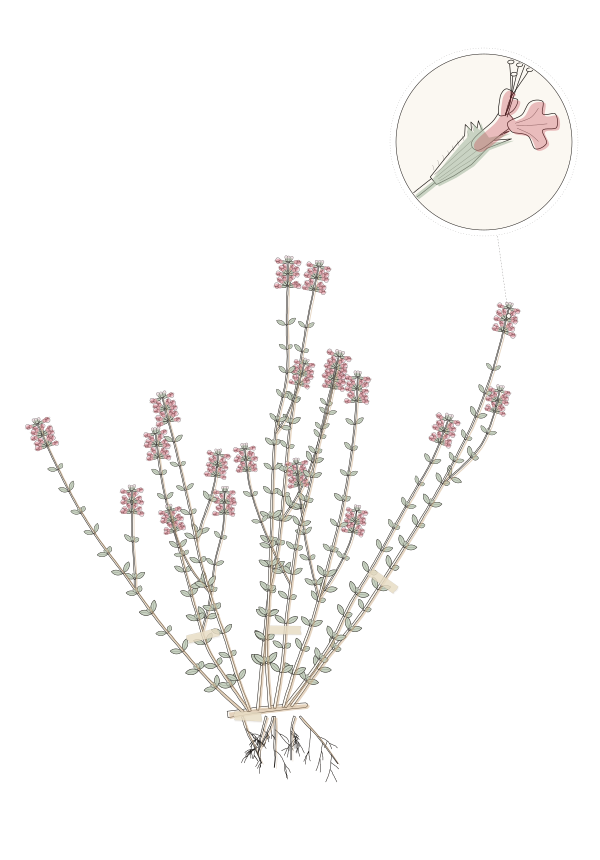
Herbarium-style drawing of thyme: many slender stems with small paired leaves and clustered flower heads rising from a woody base with roots, taped to the sheet; a circular inset magnifies one flower.
Pl. IThymus vulgaris, herbarium-style drawing. a, flower, magnified: tubular calyx and two-lipped corolla. Illustrative, not to scale.

Plate I01 / 05

Thymus vulgaris L.

Thyme Lamiaceae, the mint family

Many slender stems rise from a woody base, set with small paired leaves and ending in clustered whorls of tiny flowers.

In the formulation
One of the five standardised extracts⁠2
Part used & share
To be confirmed by the manufacturer
Traditional use & chemistry
Notes to follow, with references
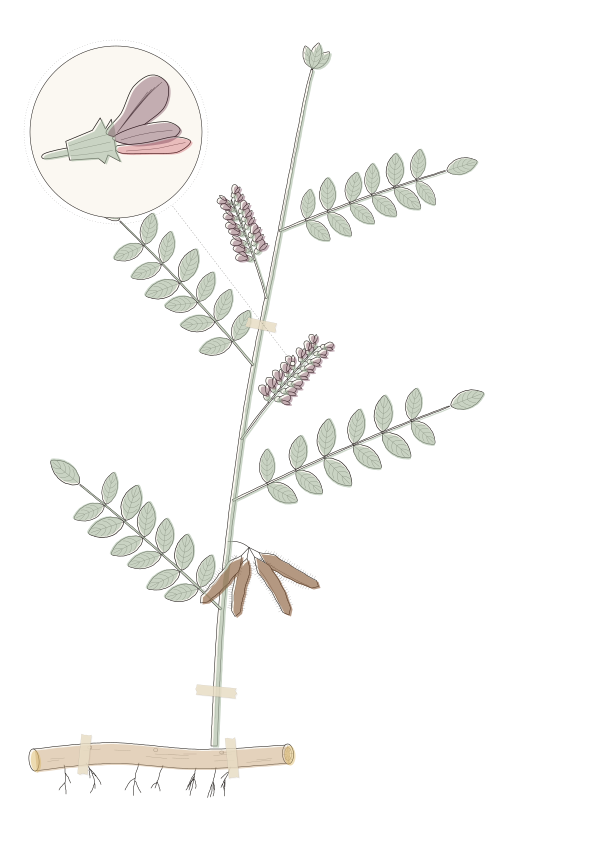
Herbarium-style drawing of liquorice: an upright stem with pinnate leaves, two flower spikes, a cluster of pods and a horizontal cut root at the base; a circular inset magnifies one pea-type flower.
Pl. IIGlycyrrhiza glabra, herbarium-style drawing. a, pea-type flower, magnified: banner, wing and keel. Illustrative, not to scale.

Plate II02 / 05

Glycyrrhiza glabra L.

Liquorice Fabaceae, the legume family

An upright stem with feather-like (pinnate) leaves, spikes of small pea-type flowers, a cluster of flattened pods and a length of cut root.

In the formulation
One of the five standardised extracts⁠2
Part used & share
To be confirmed by the manufacturer
Traditional use & chemistry
Notes to follow, with references
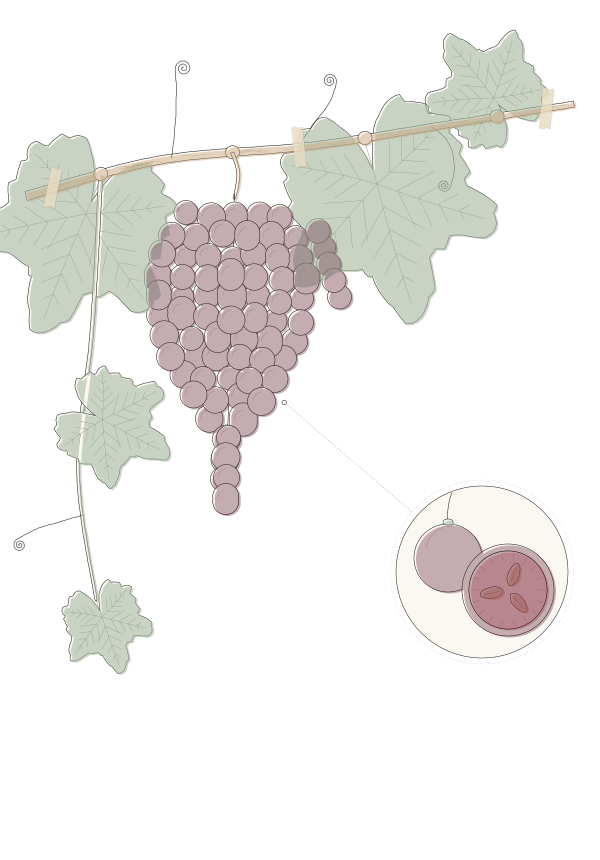
Herbarium-style drawing of grape vine: a woody cane crossing the sheet with lobed leaves, coiled tendrils and a hanging bunch of grapes; a circular inset shows a whole berry and a berry cut open with its seeds.
Pl. IIIVitis vinifera, herbarium-style drawing. a, berry, whole and in section, showing the seeds. Illustrative, not to scale.

Plate III03 / 05

Vitis vinifera L.

Grape vine Vitaceae, the grape family

A woody cane with broad, lobed and toothed leaves, coiling tendrils and a hanging bunch of grapes.

In the formulation
One of the five standardised extracts⁠2
Part used & share
To be confirmed by the manufacturer
Traditional use & chemistry
Notes to follow, with references
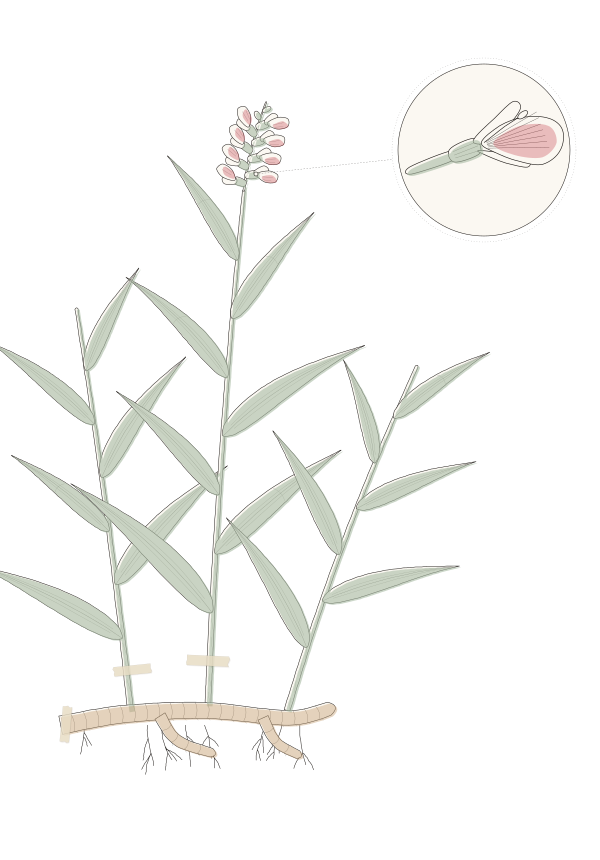
Herbarium-style drawing of lesser galangal: three leafy shoots with long narrow leaves rising from a ringed rhizome with roots, the tallest ending in a flower spike; a circular inset magnifies one flower.
Pl. IVAlpinia officinarum, herbarium-style drawing. a, flower, magnified, with its veined lip. Illustrative, not to scale.

Plate IV04 / 05

Alpinia officinarum Hance

Lesser galangal Zingiberaceae, the ginger family

Leafy shoots with long, narrow leaves in two ranks rise from a ringed, knotted rhizome; the tallest ends in a spike of flowers.

In the formulation
One of the five standardised extracts⁠2
Part used & share
To be confirmed by the manufacturer
Traditional use & chemistry
Notes to follow, with references
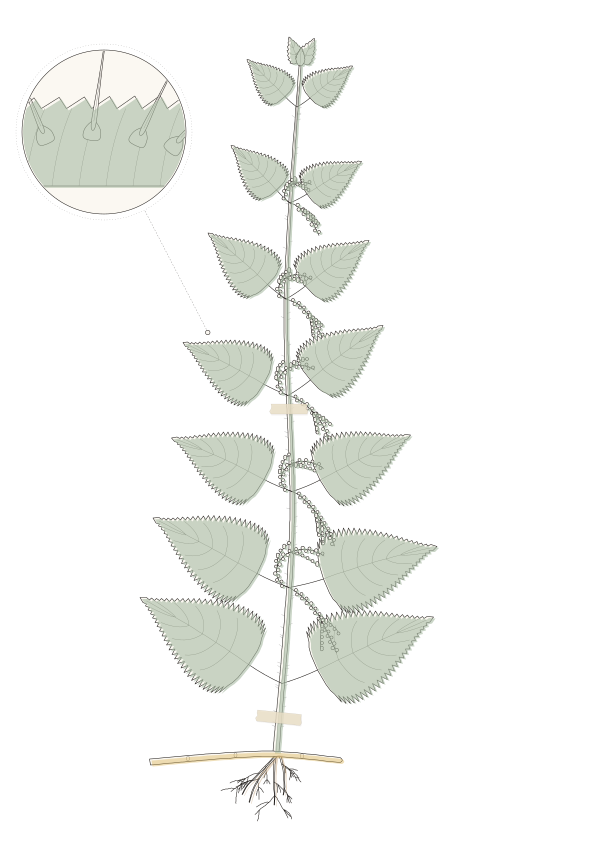
Herbarium-style drawing of stinging nettle: one upright stem with paired, toothed leaves and hanging flower strands, roots at the base; a circular inset magnifies the leaf edge and its stinging hairs.
Pl. VUrtica dioica, herbarium-style drawing. a, leaf margin, magnified, with stinging hairs. Illustrative, not to scale.

Plate V05 / 05

Urtica dioica L.

Stinging nettle Urticaceae, the nettle family

A single upright stem with paired, coarsely toothed leaves and slender flower strands hanging from the leaf axils.

In the formulation
One of the five standardised extracts⁠2
Part used & share
To be confirmed by the manufacturer
Traditional use & chemistry
Notes to follow, with references

Why there are no claims per plantThe published work studies the combined, standardised mixture⁠5. We do not attribute any effect to a single plant. Traditional-use and phytochemical notes will be added only with references.

03 · Timeline

A dated timeline.

Regulatory milestones and key publications, with their dates. One earlier origin has no single date.

Published milestones

  1. 2007

    Intermediate-product permission

    The Turkish Ministry of Health grants intermediate-product permission (per the manufacturer).

  2. 2008

    Haemostatic actions described

    Goker, Haznedaroglu and colleagues publish “Haemostatic actions of the folkloric medicinal plant extract Ankaferd Blood Stopper” in the Journal of International Medical Research⁠1.

  3. 2012

    CE certificate

    First CE certificate as a Class III medical device under Directive 93/42/EEC, notified body TSE (per the manufacturer).

  4. 2013

    Use in the airways reported

    Endobronchial instillation for haemoptysis, a retrospective series of 20 patients⁠6.

  5. 2017

    Proteomic & transcriptomic analyses

    Analyses aimed at explaining its pleiotropic effects appear in SAGE Open Medicine⁠2.

  6. 2017

    Pharmaceutical licence

    A pharmaceutical licence is granted (per the manufacturer).

  7. 2020

    “From molecules to medicine”

    A review of the proposed mechanism and clinical use in the Turkish Journal of Medical Sciences⁠5.

  8. 2025

    “Beyond hemostasis”

    A narrative review of its wider, still investigational, therapeutic potential, calling for controlled trials⁠3.

Earlier origin

  1. No fixed date

    A folk remedy

    Described as a folkloric medicinal plant extract⁠1; there is no single date for its earlier use as a remedy.

  2. From 2008

    Scientific groundwork

    Its introduction was supported by research at the haematology department of Hacettepe University and the publication of findings⁠1; the product was not developed at the university.

04 · Quality & manufacturing

Tested for what should not be there.

Contaminant testing reported in the literature, next to the manufacturing documentation we are still gathering.

Contaminant screen

As reported⁠5

Contaminants tested and the reported result
Tested forReported result
Heavy metals Pb · Cd · Hg · AsNegative
PesticidesNegative
AflatoxinsNegative
GMO materialNegative
DioxinsNegative
Results as published. Batch certificates of analysis: available on request (confirm).

From plant to product

  1. 01

    Plant material

    Five plants, identified and sourced. Sourcing details to follow.

  2. 02

    Extraction

    An extract from each plant. Method to be documented.

  3. 03

    Standardised mixture

    The five extracts combined as a standardised mixture⁠2.

  4. 04

    Testing

    Contaminant screen reported negative⁠5. Batch release: to be confirmed.

Certification & manufacturing site to be confirmed

05 · Company

The company behind it.

Legal name
Company legal name
Headquarters
Address to be confirmed
Founded
Year to be confirmed
Academic link
Hacettepe University haematology department, as described⁠4 (nature of link to confirm)

Team profilesThe founder, medical and quality teams will be introduced here once their details are confirmed. We will not show people or photographs before then.

For healthcare professionals

Questions about the product or its origins?

Ask about composition, evidence, availability or the Instructions for Use. Enquiries from clinicians, pharmacists and procurement teams are welcome.

References on this page (6)
  1. [1]Goker H, Haznedaroglu IC, et al. Haemostatic actions of the folkloric medicinal plant extract Ankaferd Blood Stopper. J Int Med Res. 2008. Volume and pages to be confirmed.
  2. [2]Simsek C, Selek S, Koca M, Haznedaroglu IC. Proteomic and transcriptomic analyses to explain the pleiotropic effects of Ankaferd blood stopper. SAGE Open Med. 2017;5:2050312117722569. doi:10.1177/2050312117722569
  3. [3]Tibi SE, et al. Beyond hemostasis: a narrative review on the multifaceted therapeutic potential of Ankaferd Blood Stopper. Ann Med Surg. 2025/26;88(1):522–533. doi:10.1097/MS9.0000000000004388
  4. [4]Wikipedia contributors. “Ankaferd Blood Stopper.” Wikipedia, The Free Encyclopedia. Encyclopaedic secondary source, used here for history and status only. Primary sources to follow.
  5. [5]Çiftçiler R, Haznedaroğlu İC. Ankaferd hemostat: from molecules to medicine. Turk J Med Sci. 2020;50(7):1739–1750. doi:10.3906/sag-1908-161
  6. [6]Uzun et al. 2013. Endobronchial Ankaferd Blood Stopper for haemoptysis, n = 20, retrospective; as summarised in Simsek et al. 2017 [2]. Full citation to be confirmed.